

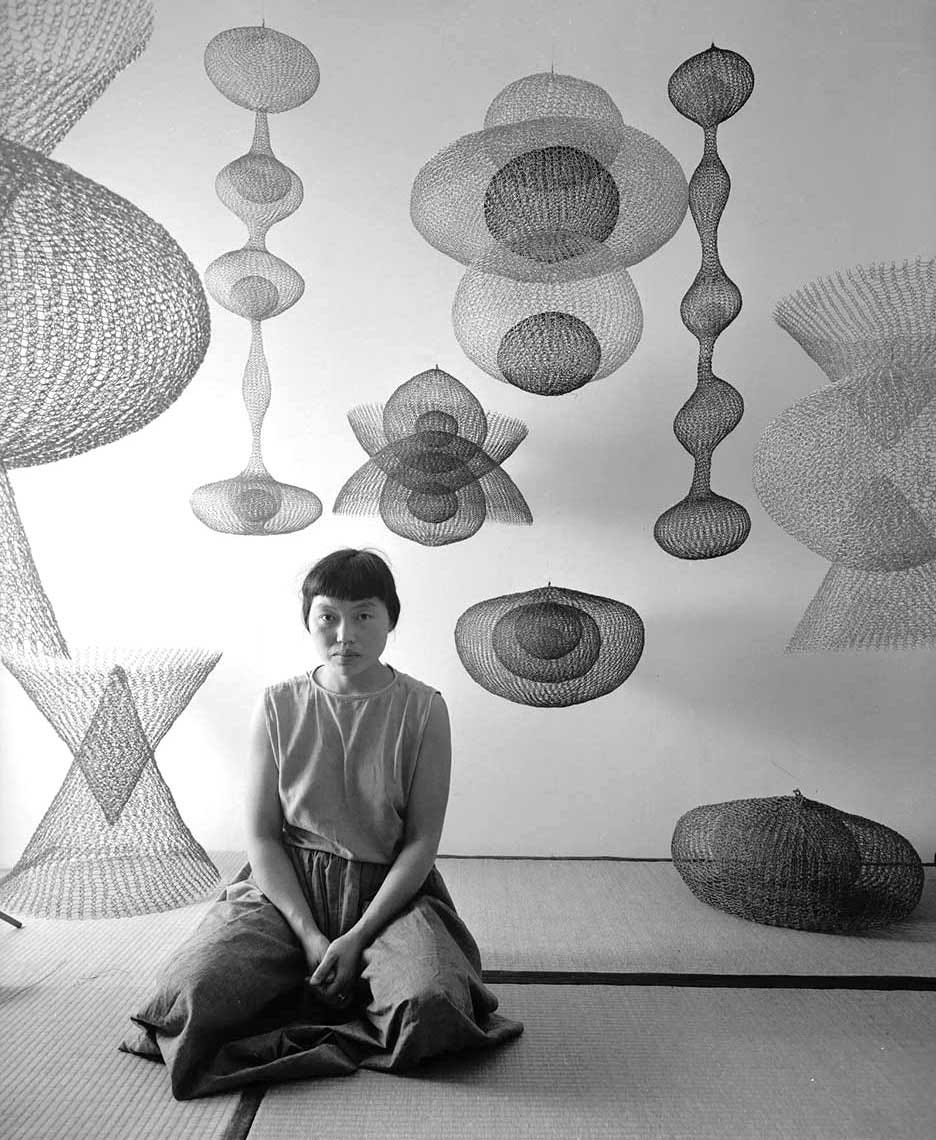
The sculptor Ruth Asawa, who spent half a century looping wire into forms that seem to hold their breath, said that everything is connected. Continuous. She was talking about the sculptures—those hanging spheres whose outer surface becomes the inner surface of the next; circle one slowly and you discover there is no edge, no place where one shape surrenders to another. But she was not only talking about the sculptures. She was describing a way of being alive, and the sculptures were the argument.
She came to it early, in the dirt. Asawa grew up on a truck farm in California, the daughter of Japanese immigrants who worked the fields until the light gave out, and her first sense of time was the ground’s, not the clock’s. Planting running into growth, growth into harvest, harvest into the slow rot that fed the next planting, nothing ever announcing its own ending. She made an entire body of work that behaves the way the farm behaved: surfaces turning back into themselves, forms carrying other forms inside them.
Most of us draw lines instead, like between work and rest, between the one hour we set aside for beauty and the twenty-three we don’t—and we sort our lives into categories that don’t quite touch, and we call that being organized. We never count the cost of the sorting: the day disappearing into the seams, the closing of one thing, the opening of the next. A life spent managing borders is a life lived mostly at borders.
Asawa’s proposal—made in wire and sustained over decades—was that the borders aren’t really there.
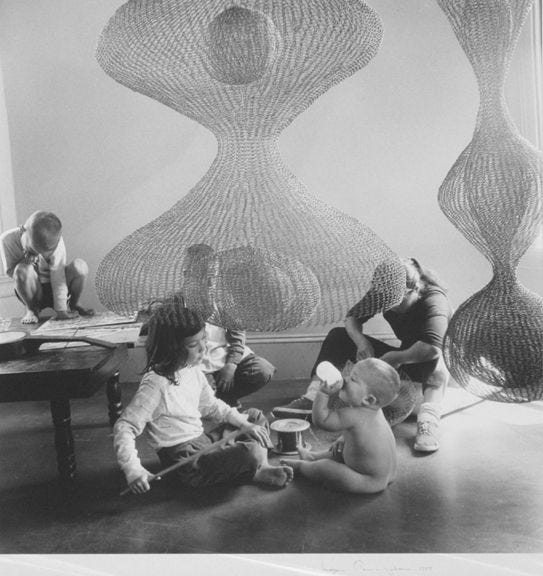
There is a photograph of her: she sits on the floor of her living room, wire pooling in her lap, while a few of her children play around her. She isn’t stopping to be a mother, and she hasn’t stepped away from her work; she’s doing both at once, because in her practice there was no seam to cross. Work didn’t wait outside the house. It sat on the floor with everything else.
This is a harder idea than balance, which is still a fence-builder’s word, or multitasking, which is only running faster between the fences. What Asawa understood was deeper than that: the borders are an invention, and much of what we call distraction is the friction of maintaining categories that aren’t true.
Great art doesn’t honor the frame we put around it. It stays with us on the drive home; it changes what you notice at dinner; it shows up the next morning, uninvited, in a conversation about something else. Which is part of the frame’s power: its not a boundary, only a doorway, and doorways open both directions.
Which is why the question worth carrying out of a gallery is not what did I see but what has become continuous with me: what has crossed over, what now belongs to the same surface as the rest of the day.
Asawa said she worked in wire because with it she could define the air without stealing it from anyone—a line, she said, can enclose space while letting the air remain air. It is hard to hear that only as a note on sculpture. It’s a way of moving through the world. Taking up space without pushing anything else out of it, making room for what is already there.
That is what a certain kind of attention does. It doesn’t add or perform. It stops drawing lines that were never there, and lets the world become continuous with itself again.
The exhibitions worth catching this month follow.
The Art Signal - Art Openings and Show Guide Below
