


Most of us walk into a museum or gallery the same way we walk into a supermarket without a list. We wander. We pick up whatever catches our eye. We leave having consumed something, but not quite sure what, or why.
There’s a better way to go in.
The philosopher Alain de Botton suggest thinking about art the way we think about medicine. Not really in a clinical sense, but in the sense that we go to a pharmacy with a specific ailment in mind. We don’t just browse the shelves hoping something will randomly improve our health. We arrive knowing what we need, and we look for the thing that addresses it.
"The art that will actually reach you isn't necessarily the most famous work in the room — it's the one that contains what you are currently missing."
The same logic applies to art. Before you visit a gallery or open an art book, or scroll online for inspiration, ask yourself one honest question:
What is the dominant weather of my inner life right now?
Are you anxious? Overstimulated? Numb? Grieving something you haven’t named yet? Feeling small, or disconnected, or weirdly restless without knowing why?
Your answer is your prescription.
WHAT THIS LOOKS LIKE IN PRACTICE
A person coming apart at the seams could find relief in standing in front of one of Claude Monet’s paintings at the High; one that captures a perfect, subtle reflection of the landscape in the water below that gives the feeling of having all the time in the world. Someone who has forgotten what tenderness looks like might find it again in ten minutes with The Funeral of Atala, the kind of painting that asks nothing of you except to notice how gently it regards its subject.
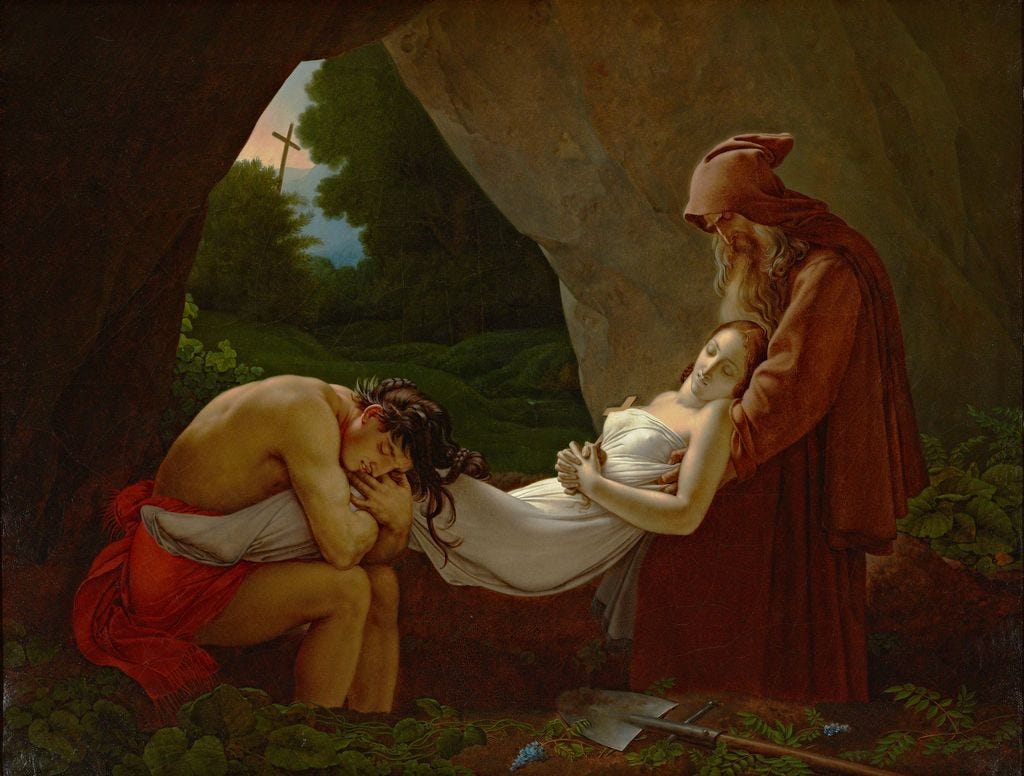
The Funeral of Atala by Anne-Louis Girodet de Roussy-Trioson
The prescription is personal. Nobody can write it for you.
The typical approach to art → chronological, historical, comprehensive; treats the gallery like a library to be catalogued. The apothecary model treats it as a resource to be used. It puts you, and your specific human condition at this specific moment, at the center of the experience.
It gives you permission to ignore the placard, skip the “high-profile” rooms, and spend twenty minutes with one mysterious work that happens to say something true about your life right now.
Its not about ignoring the cultural importance of the works. We’re just giving art the space to do what it was always meant to do.
QUESTIONS TO WORTH SITTING WITH
→ What is the dominant weather of your inner life right now and what kind of art is its opposite?
→ If you could prescribe yourself one hour in a museum this week, what emotional state would you be trying to treat?
→ What piece of art has felt like relief recently, not just beautiful, but specifically relieving?
Before your next visit to the High, or your next random scroll thru IG — spend two minutes with the question: what do I actually need right now? Then let that be your guide, not what’s trending at the moment.
Let your need be the map.